Patent pending • CURRENTLY IN final testing and prototyping STAGE
Wind energy, redesigned as architecture.
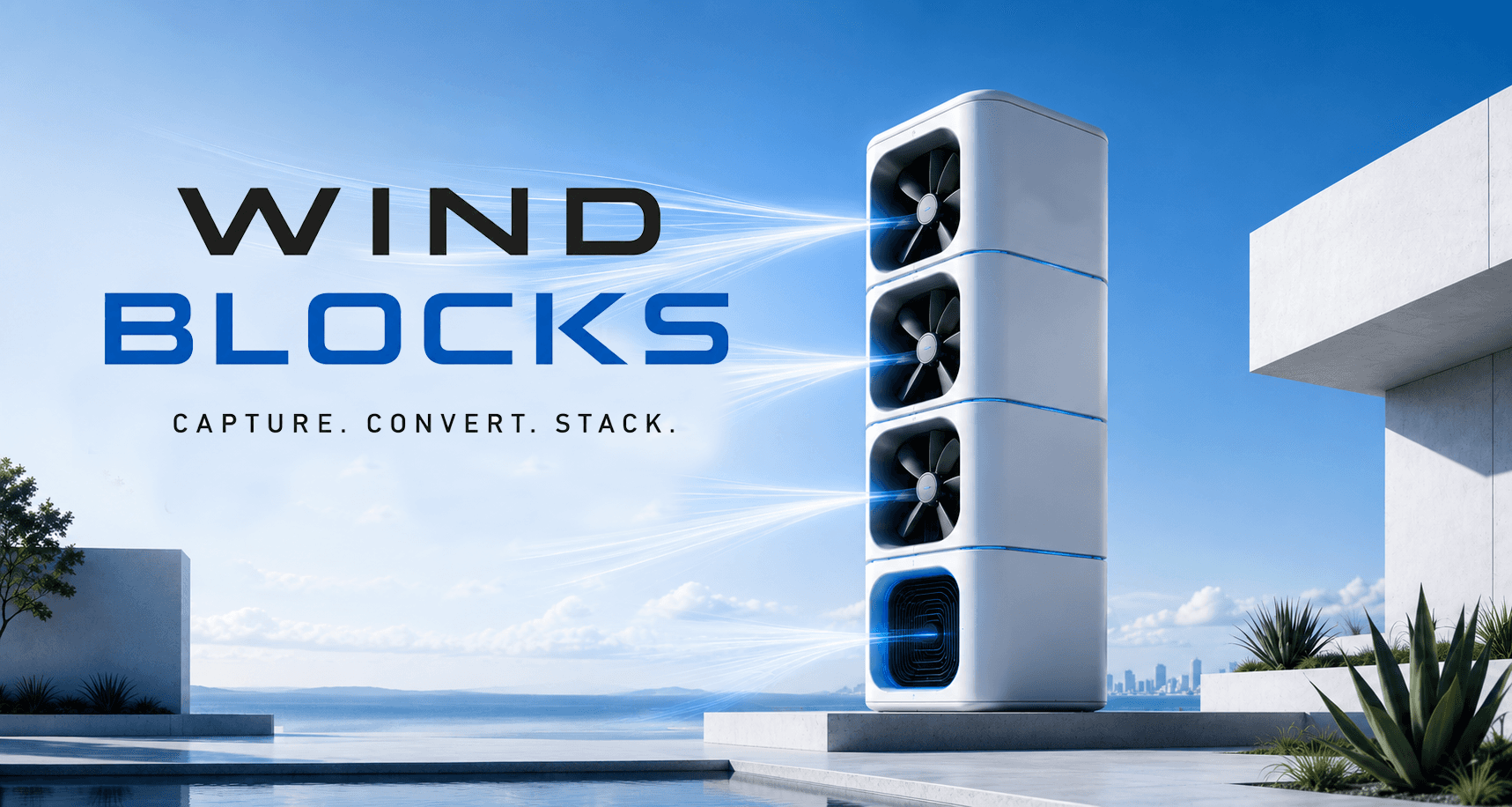
Wind Blocks is a modular stacked wind capture and energy generation system that directs naturally occurring airflow through enclosed, scalable architecture for open-air and building-integrated use.
Wind Blocks
A modular wind capture that scales like building blocks.
Instead of relying on a single large exposed rotor, Wind Blocks use stackable generator modules, airflow collectors, and a shared internal shaft to capture, accelerate, combine, and recover energy from wind across the height of the structure.

Modular
Interchangeable sections can be added, removed, replaced, or serviced, allowing systems to scale from small installations to larger towers without changing the core architecture.
Stackable
Stacked modules form a continuous internal airflow passage, letting residual airflow from multiple intake stages combine for additional downstream energy recovery.
Architectural
Enclosed modules can be freestanding, attached, recessed, or built into walls, columns, façades, fences, monuments, towers, and other architectural features.
How it works
How Wind Blocks capture and reuse airflow.
Each module captures incoming wind, accelerates it through an internal passage, then sends remaining airflow into a shared shaft where additional energy can be recovered.

Technical diagram: module intake, shared shaft airflow, and shaft-mounted recovery fans.
01 Capture
Large rounded-square collectors gather wind from the face of each module and direct it inward.
02 Accelerate
A narrowing passage concentrates airflow before it reaches the primary generator fan.
03 Combine
Air that remains after each module continues into the shared central shaft.
04 Recover
A secondary shaft generator spaced every two modules can capture leftover airflow for extra power.
Because the moving components are enclosed, Wind Blocks are designed to reduce noise, limit exposure to debris and wildlife, and simplify service access.
Design
Built to look intentional wherever it lives.
Wind Blocks can be specified with exterior finishes and architectural treatments that suit homes, farms, industrial sites, civic infrastructure, and premium installations.

Exterior direction: modern white, natural wood, industrial metal, earth tone, and premium black finish options.
Applications
One wind platform, many places to generate energy.
Because the modules can be freestanding, attached, recessed, or integrated into structures, Wind Blocks can support a wide range of residential, commercial, industrial, governmental, agricultural, transportation, utility, and emergency-response environments.
Residential
Homes, garages, detached workshops, backyard systems, fences, privacy barriers, neighborhood entrances, apartments, and condominium developments.
Commercial
Office buildings, retail centers, hospitality properties, parking garages, campuses, and energy-generating architectural features.
Industrial
Industrial facilities, warehouses, distribution centers, manufacturing plants, agricultural buildings, remote sites, and utility-scale towers.
Government
Civic buildings, schools, universities, hospitals, military installations, parks, bridges, streetlight poles, and transportation infrastructure.
Disaster relief
Deployable generation for disaster relief, off-grid communities, microgrids, telecommunications infrastructure, recovery zones, and temporary power needs.
Company overview
Cooper Park Innovations is building a portfolio of clean technology products for energy, resilience, and the built environment.
Cooper Park Innovations develops renewable-energy and sustainable-infrastructure technologies that combine performance, efficiency, practical engineering, and modern aesthetics. The company focuses on research, intellectual property development, and commercialization, creating adaptable systems for residential, commercial, industrial, government, and utility-scale applications.
Patent pending
Final testing and prototyping stage.
The current focus is validating Wind Blocks as the company’s first product platform while building a broader portfolio of cleaner, smarter technologies designed to solve real-world infrastructure challenges.
01 Module and airflow validation
02 Multi-stage energy recovery
03 Architectural integration path
Fundraising
Seeking aligned capital to move Wind Blocks from prototype to field-ready systems.
Cooper Park Innovations is opening conversations with investors, strategic partners, and early backers who believe clean technology can be distributed, beautiful, and built directly into the places that need it.
Use of funds
Prototype refinement, airflow testing, service-panel design, site demonstrations, technical documentation, and manufacturing pathway exploration.
Why now
Cities, campuses, farms, facilities, and homes need cleaner distributed generation that can integrate into the built environment without the footprint of conventional turbines.
Investor conversations
Request the brief, learn the testing roadmap, and discuss how strategic capital can accelerate protected, scalable, building-integrated wind generation.
Interested in the investor brief or partnership roadmap?
Contact investors
Early access
Follow the Wind Blocks prototype journey.
Join the waiting list for prototype updates, testing notes, partnership openings, and future product availability from Cooper Park Innovations.

Steven Cooper
Founder & CEO • Cooper Park Innovations
About the founder
A founder’s journey from resilience and creativity to future-focused infrastructure.
Steven Cooper built his career from the ground up as an independent artist and entrepreneur, founding Bigger Entertainment, growing a catalog of more than 20,000 music masters and publishing rights, creating the Midwest Made clothing brand, and expanding into acting. Years later, a vivid dream of a futuristic city filled with new technologies inspired him to think differently about energy, infrastructure, and everyday life. That vision eventually became Wind Blocks™ — the first flagship innovation from Cooper Park Innovations.
Guiding belief
Technology should solve real problems, improve quality of life, and make essential resources — including clean energy and clean water — more accessible and affordable through innovation. Let’s go to the future, together.